This summary is drawn from a larger study, done in collaboration with Princeton University Economic Development Organisation (PUEDO), that explored the impact of Bio-input Resource Centres in Southern Rajasthan in the context of changing climatic conditions.
There is a sentence a farmer in the Udaipur hills said to one of our field teams in the duration of the study: “the rain still comes, but it no longer keeps its appointments.”
In 2025, four groups - Princeton University Economic Development Organisation (PUEDO), an SBI fellow, the Research team and the NRD (Natural Resource Development) team at Seva Mandir— came together to help understand this shift, and to test an idea: to figure out whether a small, village-level institution called a Bio-Input Resource Centre might be one of the most practical tools we have for helping tribal farmers adapt to climate change.
What follows is what they found.
The sky and the earth
The researchers tracked how temperature and rainfall moved against crop yields across Rajasthan from 1991 to 2017. The finding:
For every 1 C that maximum temperatures rise during the monsoon growing season, crop yields fall by roughly 10 percent. For farmers depending entirely on rain, with no irrigation to fall back on, that loss climbs toward 21 percent.
Rajasthan's soils are nutritionally depleted. Add to it another cruel paradox — there is more total rainfall but because it falls in violent bursts that run off the surface, the poor soil becomes even thinner.
Into this, the standard response has been chemical fertiliser -degrading the soil further over time.
The people taking the hardest hit
Rajasthan has a larger proportion of small (less than 1-2 hectares of land) rural farmers compared to national rates. These are precisely the households with the highest dependence on a single rain-fed season.
When yield falls 10 or 20 percent, a large landholder loses profit; a marginal tribal farmer loses the year.
Rajasthan now sits among the four most climate-vulnerable states in India.
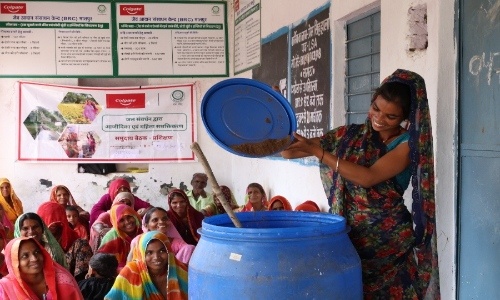
The impact of a BRC
At its simplest. a Bio-Input Resource Centre can be a shed, with two or three farmer-entrepreneurs, and about ₹30,000 of startup cost.
From it, they produce and sell locally-made organic inputs — Jeevamrut, Beejamrut, Nimastra — made largely from cow dung, cow urine, neem, and jaggery.
|
Per acre, per season
|
Chemical farming
|
Natural farming via BRC
|
|
Fertilisers
|
₹3,000–5,000
|
₹300–600
|
|
Pesticides
|
₹2,000–3,000
|
₹200–400
|
|
Soil enhancers
|
₹1,000–1,500
|
₹100–200
|
|
Total input cost
|
₹6,500–10,500
|
₹600–1,400
|
A comparison between the costs of the two types of farming, showcasing the financial impact of BRCs
That is an 80 to 90 percent reduction in what a farmer spends to plant a season. In Rajasthan specifically, farmers who moved to organic practice saw net income rise by roughly 33 percent
The complications
If the case for BRCs were simple, scaling them was easy. The difficulty sits not in whether bio-inputs work, but in the transition.
In the first season or two, there is a dip in yields. Another issue is of perishability. Liquid Jeevamrut lasts about a week, Nimastra a day or two, Beejamrut essentially not at all. So these cannot be stocked, but have to be made on demand. The third issue is that bio-inputs are a soil answer, while part of what the climate data describes is a water problem.
Bio-inputs can be a complement to water, never a replacement for it. No single input protects every crop.
There is little dispute that the rains no longer arrive on schedule. What these findings offer is a way to meet unpredictability with some solutions: healthier soil, lower costs, restored knowledge, and a small institution owned by the village itself. It is a capacity built up — which, in the end, is the only kind that lasts.
With gratitude to our SBI fellow — Armaan, the Seva Mandir team —Aasiya and Rajesh, and the PUEDO team — Luke, Sania, Mohemeen, Manuel, and Adam — whose work made this telling possible.